Toponymy of Islamic Origin in Portugal Names That Remember What History Forgets The Islamic presence in the Iberian Peninsula did not end at the borders of what is now southern Spain. It flowed further west. Into what we call today Portugal, into the lands once known as Gharb Al-Andalus, the Western edge of a civilization that did not recognize borders the way we do today. In the Algarve. In the Alentejo. In valleys, hills, and coastal winds. There, something remains. Not in monuments alone, but in names.
Toponymy, the naming of places, is not innocent. It is memory carved into language. And in Portugal, many of these names still carry echoes of Arabic origins, quietly preserved through centuries of change. One hears them without always knowing: Benagil. Benamor. Benavente. Benfica. They sound familiar, almost native. And yet, they speak another story.
In the Arabic world, names were often rooted in lineage. The word ibn, son of, appears in many forms: aben, iben, ben. The plural banū, meaning sons, clan, or tribe, was often reduced over time, shaped by tongues, softened by centuries, until it became part of the Iberian soundscape. But beneath these transformations, the structure remains. A people named through their belonging. A land marked by its inhabitants.
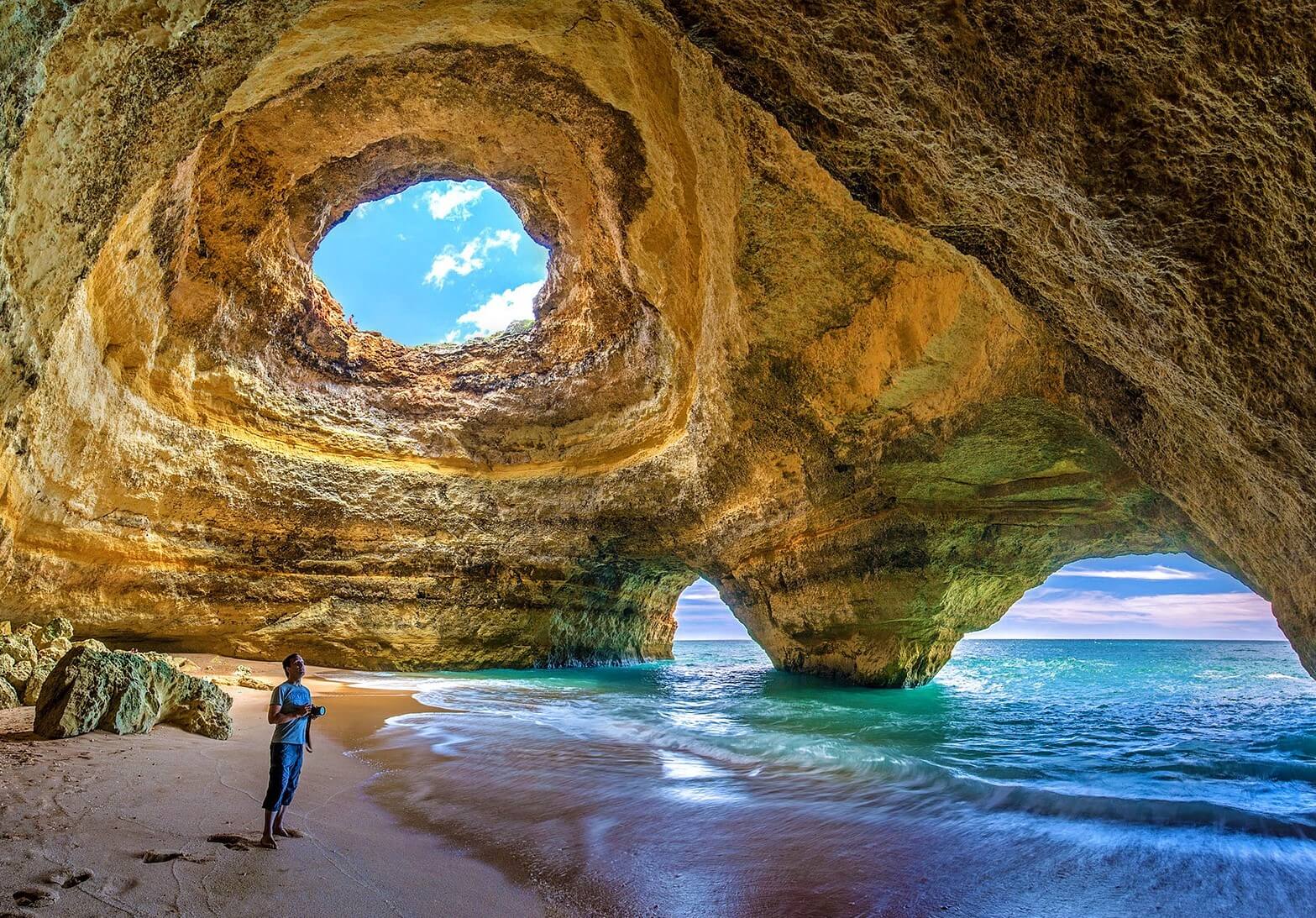
Scholars have long traced these traces. José Leite de Vasconcelos observed names such as Benevides and Benavides, linking them to older forms of lineage. Ramón Menéndez Pidal found in Beneegas and Benegas the echo of “son of Egas.” David Lopes explored names like Benamor, where layers of meaning, Arabic, Latin, and Portuguese, intertwine over time, as if language itself were negotiating its memory. Each name is not a word. It is a passage. Even today, the land speaks. Take the well-known Benagil cave. The name itself tells a story. Al-Ghar, the cave. Benagil, a lineage, a people. The place is not only geographical. It is genealogical. And even the region, the Algarve, comes from al-Gharb, meaning the West. A direction. A horizon. A frontier once shared. If one listens carefully, a map emerges, not of borders, but of presence. Names such as: Abenebaci — son of al-Bājī Belamandil — the sons of Mandīl Bela Salema — the sons of Sālim Belixe — the sons of Layth Benaciate — the sons of the fisherman Benaçoitão — the sons of the Sultan Benafin — the sons of ʿAffān Benamor — the sons of ʿAmmār Benavente — the sons of ʿAbbād Benfarras — the sons of Faraj Bensafrim — the sons of the desert Bobadela — Abū ʿAbd Allāh Boliqueime — Ibn al-Ḥakīm Budens — Abū Dānis Each one carries a fragment of a forgotten presence. Not forgotten by the land. Only by memory.
These names remind us that Western Al-Andalus was not a distant extension of a civilization. It was part of it. A lived space, structured not only by governance, but by family, tribe, and belonging. And though political realities changed, Though kingdoms rose and fell, Though languages shifted and faiths redefined the public space— The names remained. Quietly. Persistently. History is not only written in books. It is written in the way we call a place.
Over time, these traces did not disappear. They transformed. Intermarriage, migration, and exchange wove together populations across the Iberian Peninsula and the Maghreb. Portuguese presence along the Moroccan Atlantic coast—Azemmour, Mazagan, Mehdia, Essaouira, created further crossings, further entanglements of bloodlines and memory. Stories are told of people moving, of women brought across shores, of families formed in the space between necessity and history.
Whether told fully or partially, these accounts point to one reality: The Mediterranean and Atlantic worlds were never isolated. They were intertwined. So today, when one hears a name like Benfica or Benagil, it may sound purely Portuguese. But somewhere within it, a structure remains. A son of someone. A people of somewhere. A memory of belonging. Toponymy does not forget. It waits.
For someone to listen again.