Whatever Happened to Overland Travel?
There was a time when reaching a place was part of understanding it.
We traveled by road because the road let us see what lay between the names printed on the map. Cities did not simply follow one another on an itinerary. Between them were mountains, farms, villages, forests, rivers, roadside cafés, markets, breakdowns, conversations, uncomfortable nights and unexpected friendships.
We called it overland travel.
It was not always comfortable. Sometimes it was dusty, slow and unpredictable. But perhaps that was part of its education.
Today we can cross countries in hours. We fly over landscapes that once took days to traverse. We arrive in one city, photograph its monuments, sleep in a beautiful hotel and fly to the next.
Travel has become easier.
But I sometimes wonder whether, in making travel easier, we have also made it easier to miss the country itself.
The Country Between the Destinations
Morocco makes me think about this often.
A traveler can visit Fez, fly or drive quickly to Marrakech, continue to the Sahara and return home having seen some of Morocco's most celebrated places.
But Morocco is not only Fez, Marrakech and the Sahara.
What happens between Fez and Marrakech? The road climbs into the Middle Atlas. The climate changes. Architecture changes. Agriculture changes. Cedar and oak forests appear. Shepherds move through landscapes very different from the plains surrounding Fez. Towns such as Ifrane and Azrou introduce another Morocco before the road eventually descends again.
The distance between two cities is not empty.
It has a personality of its own.
And that is what overland travel lets us discover.
Overland Travel Does Not Have to Mean Hardship
Perhaps one reason overland travel lost some of its appeal is that we still imagine it as it once was.
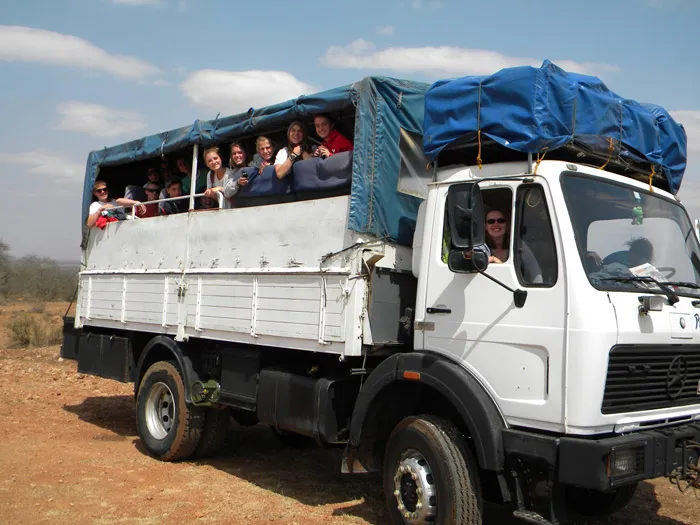
I remember another era of overland travel: long journeys, simple campsites, basic facilities, communal cooking, breakdowns, dust and considerable improvisation.
I loved much of it.
But I am not suggesting that we reproduce the discomforts of forty or fifty years ago merely because we survived them. Living in Australia has shown me another possibility.
Here, I have encountered campsites and roadside accommodations that maintain a close relationship with nature while providing remarkably good facilities. Some combine camping areas with cabins or bungalows. There may be excellent shared kitchens, clean bathrooms, hot showers, places to cook and eat together, and comfortable accommodation for people who do not wish to sleep under canvas.
The lesson is simple: Being close to nature does not require being uncomfortable.
And comfort does not necessarily require isolating ourselves from nature.
An interesting space exists between the primitive campsite and the luxury hotel.
Perhaps that space deserves exploration.
Could Camping Become Part of Travel Again?
Not camping simply because it is inexpensive.
And not “glamping” that recreates a hotel room under canvas.
I mean small-scale nature accommodation designed around the place itself.
Imagine traveling through Morocco and spending one night in a riad in Fez, another in a small lodge among the mountains, another in a simple bungalow near a village, and another beneath canvas on the edge of the desert.
Good beds. Clean bathrooms. Hot water. Good food. Shade.
A communal kitchen or gathering place.
And outside the door: the landscape you came to experience.
This kind of accommodation could also make tourism possible in rural places where constructing conventional hotels would make little environmental or economic sense.
A small camp or nature lodge can employ local people, purchase food nearby, use regional building traditions, support guides and craftspeople, and allow travelers to remain longer in communities they might otherwise simply drive through. Then accommodation itself becomes part of responsible travel.
The Return of the Road
Technology does not have to be the enemy of this kind of journey. We can have GPS and still become curious about where we are. We can carry a telephone and still put it away. We can travel in a comfortable vehicle and still stop at a village market. We can sleep in a good bed and still hear the wind outside. Perhaps the question is not whether we should bring back the overland travel of the past. We cannot.
The world has changed, and travelers have changed with it.
The more interesting question is whether we can create a new form of overland travel suited to the world we live in now, comfortable enough for today's traveler, responsible toward the places we cross, but slow enough to allow discovery.
Traveling Through, Not Flying Over
For me, the great gift of overland travel was never simply adventure. It was continuity. When you travel across a country by land, geography begins explaining culture. You understand why a town grew beside a river. Why people built with earth in one region and stone in another. Why food changes as the landscape changes. Why markets appear where roads meet. Why mountains separate communities, and sometimes connect them. Gradually, a country stops being a collection of attractions. It becomes a relationship between land and people. That is something I believe travel still has the power to reveal. Perhaps the future of overland travel will not look like its past. Perhaps it shouldn't.
But I hope we never lose the curiosity that once made us take the long road simply because we wanted to know what was there.
And perhaps the next generation of travelers will discover something some of us learned many years ago: Sometimes the road between two destinations is the destination. ** I have spent much of my life traveling, but some of the journeys I remember most clearly are not the places I reached. They are the roads that took me there. **