Bab Segma in Fez: The Historic Gate, Marinid Gardens and a City's Memory**
Fez is often described through its medina, mosques, madrasas, souks, and famous gates. But some of the city's most interesting stories survive in places that are easily passed without notice. Bab Segma is one of them.
Located north of Fez el-Jdid, near the New Mechouar and Kasbah Cherarda, Bab Segma is remembered today principally through two massive octagonal towers. At first, they may appear to be simple remnants of Fez's old fortifications. Their story, however, leads us into something much larger: a vanished royal garden, an extraordinary medieval water system, the Marinid rulers of Fez, and eventually a woman whose name became attached to the place.
Bab Segma and the Marinid Royal Gardens
The origins of Bab Segma date back to the Marinid period, when Fez was transformed by the creation of Fez el-Jdid, the new royal city founded in the 13th century. The two great octagonal towers associated with Bab Segma are believed to have formed part of an entrance to the Mosara Garden, an enormous royal garden created around 1287 under the Marinid Sultan Abu Ya'qub Yusuf. The garden has disappeared, but Bab Segma allows us to imagine something of its scale. This was not simply a small ornamental garden beside a palace. It occupied a substantial area north of Fez el-Jdid and was enclosed within its own walls.
And, as so often happens in Fez, the story of architecture soon becomes a story about water.
Water, Architecture and the Intelligence of Fez
The Mosara Garden required a sophisticated water supply. An elevated aqueduct carried water from the area of Bab Dekkakin toward Bab Segma, passing through the great octagonal towers before continuing into the royal gardens. Openings still visible in the towers show where this water system once passed. This small architectural detail tells us something important about historic Fez. A city cannot be understood only through its monuments. Behind its gardens were irrigation systems. Behind its fountains were water networks. Behind its hammams, houses, workshops, mosques, orchards, and agricultural lands was an extraordinary understanding of how water could be collected, distributed, shared, and used. Bab Segma therefore belongs not only to Fez's military architecture but also to the history of its landscape and urban engineering.
Where Did the Name Bab Segma Come From?
The name came later. Historical accounts associate it with a pious woman named Amina Sagma, who was buried near the site in 1737. Her memory became so closely connected with the place that the name Bab Segma survived as a local place-name and was eventually associated with the gate and surrounding area.
There is something particularly Fassi about this.
Cities are officially built by rulers, architects, craftsmen, and engineers. But people rename them through memory. A woman buried beside a monumental structure created centuries earlier eventually gave the place the name by which generations would remember it.
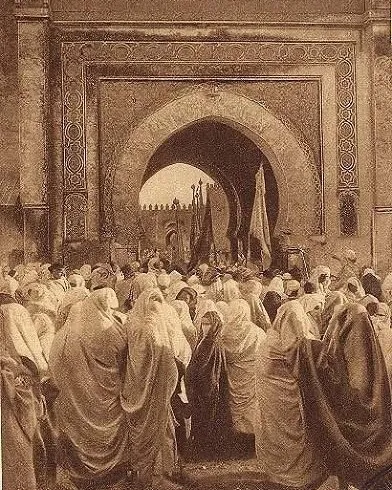
The monument belonged to history. The name belonged to memory. Bab Segma Through an Old Photograph Old photographs and postcards of Bab Segma allow us to see more than architecture. Look carefully, and the monument becomes only part of the image. Clothes, gestures, roads, animals, walls, shadows, people entering and leaving, and the landscape surrounding the city appear. What appears to be a photograph of a gate becomes evidence of how people once occupied the space around it. This is why historical photographs of Fez are so valuable. They do not merely show us what has disappeared. They show us how the city was lived. Fez: A City That Can Be Read Through Its Gates Bab Segma belongs to a much larger family of gates, walls, towers, kasbahs, and passages that developed as Fez expanded over the centuries. But the gates of Fez were never simply holes made in defensive walls. A gate could tell you where a road was going, which community lived nearby, what trade took place there, what landscape lay beyond the walls, or which political authority controlled that part of the city. Some names remembered professions. Others remembered tribes, saints, neighborhoods, markets, geographical directions, or particular events. To study the gates is therefore to begin reading the geography of historic Fez. And Bab Segma gives us an especially beautiful example because so much of what once surrounded it has vanished. The royal garden disappeared. The medieval landscape changed. The aqueduct ceased carrying water. The city expanded around it. Yet the towers remained. And so did the name.
Preserving More Than Stone
When we speak about preserving the architectural heritage of Fez, we often think first about restoring walls, gates, houses, madrasas, fountains, and monuments. That work is essential.
But preservation must also protect the stories that explain why those stones matter.
Without those stories, Bab Segma becomes two old towers beside a modern road.
With them, we begin to see a Marinid royal garden. We imagine water moving along an aqueduct. We encounter centuries of changing urban life. We remember Amina Segma. And suddenly a fragment of architecture reconnects us with the people who lived around it.
Perhaps this is one of the great pleasures of discovering Fez. The city rarely reveals everything at once.
Sometimes we must stop before two old towers and ask a simple question:
What happened here? And Fez begins to speak.